If you've looked at an IT provider's website lately, including ours, you may have noticed a new item on the services list: managed AI. The term is new enough that if you asked five providers to define it, you'd get five overlapping but different answers. That's usually how it goes in the first couple of years of any new service category. Managed IT went through the same awkward phase twenty years ago.
So it's worth laying out plainly what managed AI services actually cover, why the category exists at all, and how to tell whether your business is at the point where it needs this or can still handle AI on its own.
The Short Definition
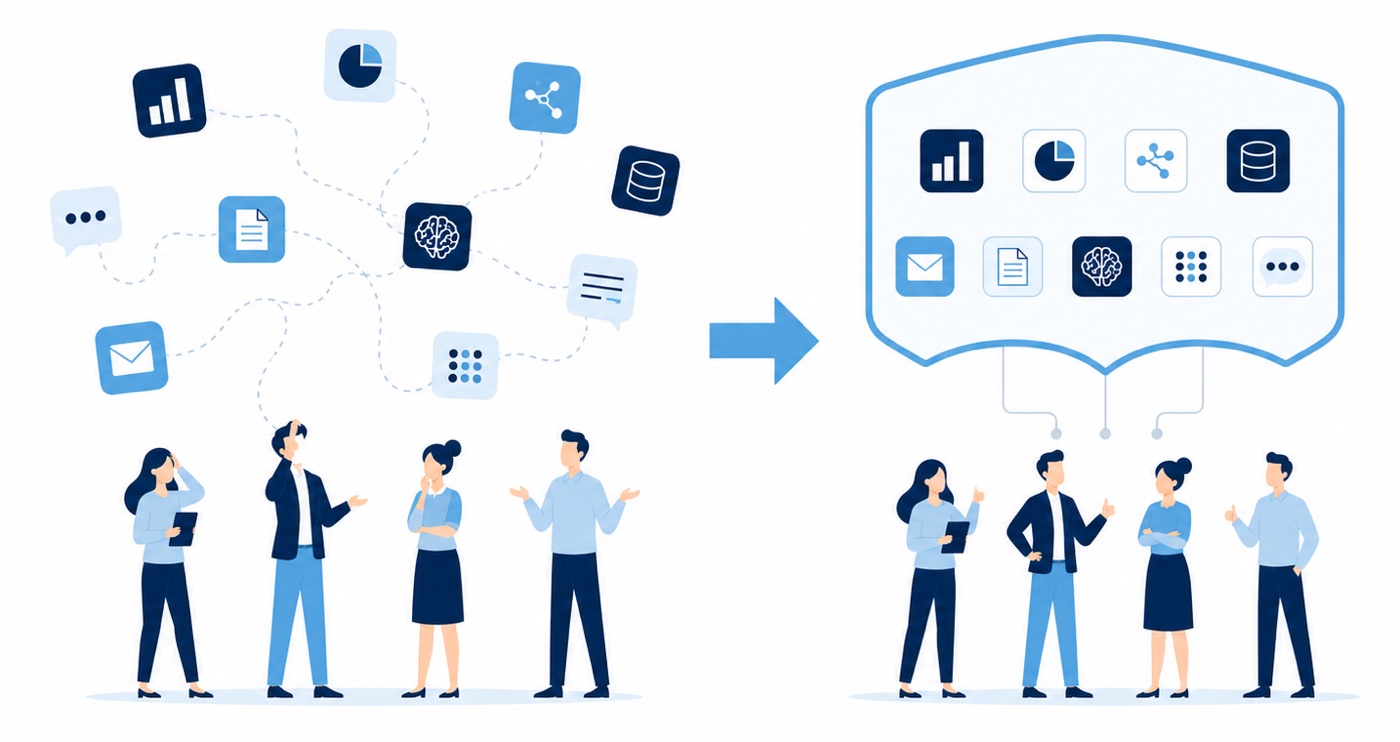
Managed AI services apply the managed IT model to your company's AI tools. An outside provider takes ownership of selecting, deploying, securing, and monitoring the AI your business uses, the same way a managed service provider handles your network, devices, and email today.
If your business already works with an MSP, the concept will feel familiar. You don't hire your own network engineer to manage firewalls; you pay a provider a predictable fee to keep that layer running, secure, and current. Managed AI does the same for a layer of your business that didn't exist a few years ago and now sits in the middle of everything: the AI tools your employees use, the data flowing through them, and the bills they generate.
Why This Became a Service Category
AI created a management problem faster than most businesses could build the ability to manage it. Three things drove that.
Employees adopted AI before businesses did. Industry research from 2026 found that 98% of organizations have employees using AI tools that IT never approved, and that the average company runs about 14 different AI tools while IT knows of 4 or 5. That gap between what's in use and what's managed is exactly the kind of problem businesses have historically outsourced. We wrote about this dynamic, and why the answer isn't banning anything, in our post on employees adopting AI ahead of the business.
AI billing works differently than software licensing. Traditional software costs a fixed amount per seat. Much of the new AI generation, including tools like Microsoft's Copilot Cowork, bills by usage with no ceiling unless someone configures one. Managing spend caps, watching usage reports, and matching the right tool tier to each employee is ongoing work, and it's work most businesses have no one assigned to.
The tools change constantly. The AI stack a business sets up today will need adjusting within months, because models improve, pricing shifts, and new capabilities keep arriving. Keeping current is a job in itself. It's the same reason patch management became an outsourced function: not because it's impossibly hard, but because it never stops.
What Managed AI Services Typically Include
Offerings vary by provider, but a real managed AI engagement generally covers six areas.
An approved, managed tool stack. The provider selects AI tools that fit how your business works, sets them up on business-grade accounts with proper data protections, and maintains the approved list as tools evolve. This matters more than it sounds: research shows that simply providing an approved tool cuts unauthorized AI use by roughly 89%, because employees aren't loyal to any particular app, just to getting work done faster.
Data protection. Business AI accounts come with contractual protections that personal accounts don't, covering how your data is stored, retained, and whether it trains anyone's models. A managed AI provider makes sure company data only flows through accounts with those protections in place, and that the workflows employees build stay with the business rather than living in someone's personal login.
Spend management. Usage caps, alerts, and monthly reporting on what AI is actually costing, configured before deployment rather than after a surprise invoice. For usage-billed tools, this is arguably the single most valuable piece of the service.
Security and governance. An AI usage policy your team can follow, review of anything AI-built before it touches production or customer data, and monitoring for the risks specific to AI, like company information leaving through unmanaged tools. Done well, this is a page of practical ground rules, not a binder.
Training and adoption. Tools only pay for themselves if people use them well. Ongoing training, use-case identification, and helping teams figure out what to delegate to AI is where a lot of the actual return comes from.
Ongoing optimization. Quarterly reviews of what's working, what isn't, where costs are drifting, and which new capabilities are worth adopting. AI is moving too fast for a set-it-and-forget-it deployment to stay right for long.
Why Small Businesses Specifically
Large enterprises are responding to all of this by hiring: AI governance leads, machine learning engineers, prompt specialists. A 20-person company is not going to do that, and shouldn't. The fully loaded cost of one specialized hire would exceed what most SMBs spend on their entire technology stack.
This is the same economics that made managed IT the default for small business. The work is real and ongoing, the expertise is expensive to employ, and the workload doesn't fill a full-time role at SMB scale. Buying it as a service gets you the expertise at a fraction of the cost of owning it.
There's also a practical timing issue. Small businesses are adopting AI at nearly the same rate as enterprises, but with none of the same oversight infrastructure. The typical SMB running a dozen AI tools has nobody watching data flows, nobody setting spend controls, and no policy anyone could point to. Managed AI exists to close that gap without requiring the business to become an AI company.
Do You Actually Need It?
Not every business does, at least not yet, and it would be a disservice to pretend otherwise.
If your team is a handful of people using one or two chat-based AI tools on business accounts, you can likely manage that yourself with a short policy and a monthly glance at billing. The value of the managed layer grows with three things: the number of AI tools in use, the sensitivity of the data flowing through them, and whether any tools bill by usage. When employees start building automations, when AI touches customer data, or when the first usage-billed tool shows up in your stack, self-management stops scaling, and that's usually the point where a conversation makes sense.
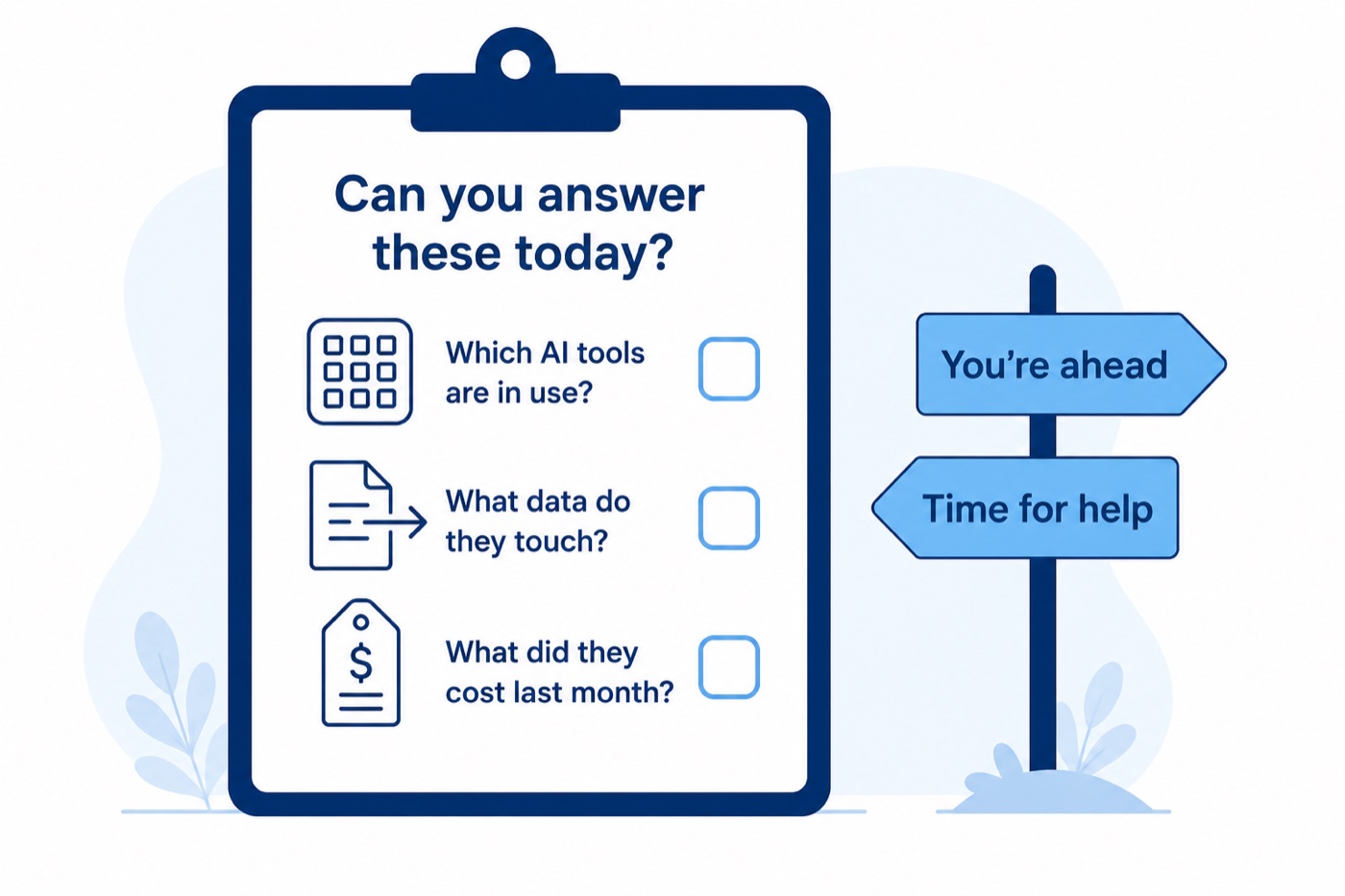
A reasonable test: can someone in your business say, today, which AI tools are in use, what data they touch, and what they cost last month? If yes, you're ahead of most. If no, that's the job managed AI was created to do.
The Bottom Line
Managed AI services are the natural extension of a model small businesses already trust. AI became a real operational layer, with its own security concerns, its own cost behavior, and its own maintenance burden, and layers like that end up either managed or neglected. There isn't much middle ground.
For businesses that want AI's upside without adding headcount to supervise it, buying the management as a service is the practical path, the same way it was for networks, email, and security before it.
Common Questions About Managed AI Services
What are managed AI services?
Managed AI services apply the managed IT model to your company's AI tools. An outside provider takes ownership of selecting, deploying, securing, and monitoring the AI your business uses, the same way a managed service provider handles your network, devices, and email today.
What do managed AI services include?
A real managed AI engagement generally covers six areas: an approved and managed tool stack, data protection, spend management, security and governance, training and adoption, and ongoing optimization. For usage-billed tools, the spend management piece is often the single most valuable part.
Does my small business need managed AI services?
Not every business does yet. If your team uses one or two chat-based AI tools on business accounts, you can likely manage that with a short policy and a monthly look at billing. The value grows with the number of AI tools in use, the sensitivity of the data flowing through them, and whether any tools bill by usage.
How is managed AI different from managed IT?
It is the same model applied to a newer layer. Managed IT keeps your network, devices, and email running, secure, and current for a predictable fee. Managed AI does the same for the AI tools your employees use, the data flowing through them, and the usage-based bills they generate.
Wondering what managed AI would look like for your business?
CNI's Managed AI service covers the tool stack, data protections, spend controls, and training, so your team gets the benefit without the babysitting. No pitch, no pressure.
Sources: Second Talent, 2026 (98% of organizations with unapproved AI use); Productiv, 2026 (14 AI tools in use vs. 4 to 5 known to IT); Healthcare Brew survey, 2026 (89% reduction in unauthorized use when an approved tool is provided); Channel Insider: AI Managed Services, How an MSP Can Help You Adopt AI; Microsoft 365 Blog: Copilot Cowork general availability (usage-based billing).